
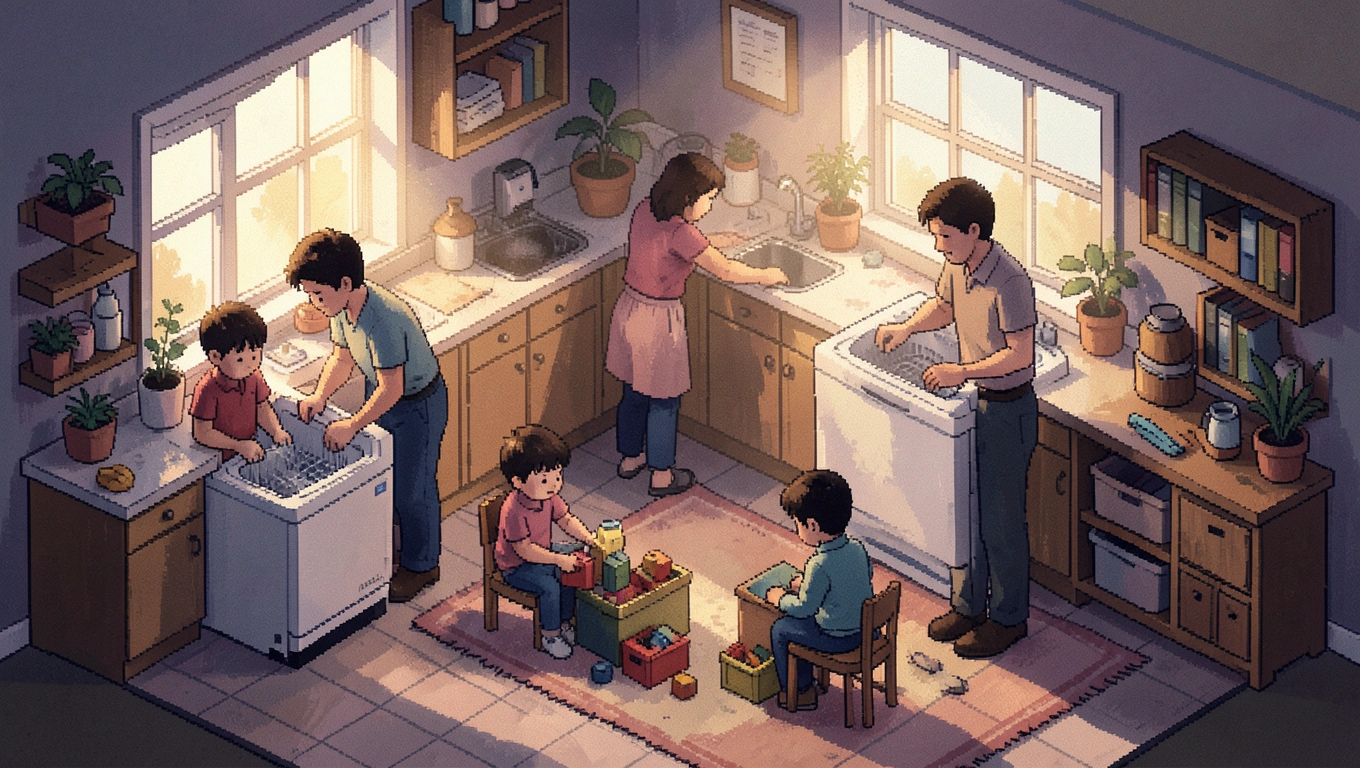
Household chores are one of those everyday realities that can quietly build resentment faster than just about anything else in family life. One person feels like they’re doing everything. Another swears they’re pulling their weight. The kids conveniently forget what day means trash duty. Before long, what started as a simple question about who last cleaned the bathroom turns into a full-blown weekly argument that nobody wanted. The good news is that families who manage to split chores without constant conflict aren’t operating on some magical wavelength – they’ve just figured out a few practical systems that take the guesswork and guilt out of the equation.
The secret isn’t about finding the perfect chore chart or motivating everyone with sticker rewards. It’s about clarity, fairness, and removing the invisible mental load that usually falls on one person. When everyone knows what needs doing, when it needs doing, and why it matters, the whole dynamic shifts from nagging and negotiating to simply getting things done.
Quick Takeaways
- Clear expectations and visual systems reduce daily negotiations dramatically
- Rotating tasks prevents one person from getting stuck with all the unpleasant jobs
- Age-appropriate responsibilities teach kids genuine life skills, not just busywork
- Regular family check-ins keep the system working as schedules and abilities change
Making the Invisible Work Visible
One of the biggest reasons chore arguments flare up is that a huge portion of household work is invisible until it stops happening. The person who notices the toilet paper is running low, adds it to the mental shopping list, buys it, and stocks the bathroom is doing real work – but it doesn’t look like anything to someone who just sees full rolls magically appearing. Research on family conflict patterns shows that arguments over housework often stem less from the physical tasks themselves and more from the mental load of remembering, planning, and coordinating everything.

The first step in splitting chores fairly is getting everything out of one person’s head and onto a shared system everyone can see. That might be a whiteboard in the kitchen, a shared app, or even a simple paper chart stuck to the fridge. The format matters less than the fact that it exists and everyone uses it. When you write down that the trash goes out Tuesday nights, the dishwasher gets emptied before breakfast, and the bathrooms need cleaning by Saturday afternoon, you’ve just eliminated dozens of micro-decisions and reminders. Nobody has to ask, nobody has to remember for everyone else, and nobody gets credit for tasks that weren’t actually their responsibility in the first place.
This visibility also helps everyone understand the sheer volume of work that keeps a household running. When the list includes not just vacuuming and dishes but also meal planning, scheduling appointments, buying birthday cards, and checking if the kids have outgrown their shoes, it becomes obvious why one person might feel overwhelmed while another genuinely thinks they’re doing half. Seeing the full picture is uncomfortable sometimes, but it’s the foundation for any sustainable solution.
Fairness Means Different Things to Different People
Here’s where things get tricky. Fair doesn’t always mean equal. A parent working long hours outside the home and a parent handling most of the childcare might both be working flat-out, even if their chore contributions look different on paper. A teenager with a packed school and sports schedule genuinely has less time than their younger sibling who gets home at three every day. The goal isn’t to split every single task down the middle – it’s to make sure everyone feels the distribution reflects effort and capacity, not just who complains the least.
🤨 The Curious Bit
Power struggles over chores often peak during transitions – moving homes, changing jobs, or kids hitting new developmental stages – because the old system stops matching the new reality, but nobody’s updated the expectations yet.
Some families assign chores by time commitment – everyone contributes roughly the same number of hours per week, but what they do varies based on ability and preference. Others focus on outcome – as long as the house stays functional and nobody’s drowning, the exact distribution can flex week to week. Still others rotate through all tasks so that everyone experiences the full range of household work, from the satisfying jobs like cooking to the genuinely unpleasant ones like scrubbing toilets. There’s no single right answer, but the conversation about what feels fair to everyone in your specific household is worth having explicitly rather than letting assumptions and resentment build.

Age matters too. A five-year-old putting away their toys and helping set the table is contributing meaningfully at their developmental level. Expecting them to do the same amount of work as a thirteen-year-old who can handle laundry and meal prep isn’t fair to anyone. The key is making sure responsibilities grow as kids do, so they’re building real skills rather than getting stuck in toddler tasks until they leave for college.
Systems That Actually Stick
The internet is full of elaborate chore systems with color-coded charts, reward points, and rotating schedules that would make a project manager weep with joy. Most of them fail within two weeks because they’re too complicated for real life. The systems that actually work long-term tend to share a few characteristics: they’re simple enough that everyone understands them without a manual, they’re visible enough that nobody can claim they forgot, and they’re flexible enough to survive the inevitable sick days, schedule changes, and weeks when everything falls apart.
A basic weekly rotation works well for many families. Each person has a set of tasks for the week, and on Sunday evening (or whenever works for your schedule), everyone rotates to the next set. This way nobody gets permanently stuck with the worst jobs, and everyone learns to do everything eventually. Household management experts point out that rotation also prevents the expertise trap, where one person becomes the only one who knows how to do something and then gets stuck doing it forever.
Some families prefer ownership models instead. Each person owns certain areas of the home – maybe one kid handles the living room, another handles the main bathroom, and the adults split kitchen and bedroom responsibilities. The advantage here is that you see immediate consequences when your area gets neglected, which can be motivating for older kids and teenagers who respond better to autonomy than to being told what to do.
Technology can help, but only if everyone actually uses it. Shared apps work great for families who already live on their phones. For everyone else, a physical chart in a high-traffic area often works better simply because you can’t ignore it when you walk past it six times a day. The best system is the one your family will actually maintain, not the one that looks impressive on Pinterest.
When Kids Resist and Partners Dig In
Even with the clearest system and the fairest distribution, you’re going to hit resistance. Kids will claim they didn’t see the chart that’s been on the fridge for three months. Partners will insist their way of loading the dishwasher is objectively correct and everyone else is doing it wrong. Someone will argue that their particular chore is harder than everyone else’s, so they should get credit for extra effort.
This is where consistency matters more than perfection. If the system says bathroom cleaning happens by Saturday afternoon, then it happens by Saturday afternoon, and there are real consequences when it doesn’t – not punitive ones necessarily, but natural ones like losing screen time or having to do a makeup chore. The goal isn’t to turn your home into a military operation, but to establish that agreements mean something and everyone’s time and effort matter equally.
For partners, the conversation often needs to go deeper than just task division. If one person is constantly redoing what the other person already did, that’s not a chore problem – it’s a control or standards problem that needs addressing directly. Sometimes good enough really is good enough, and learning to let go of perfection in exchange for shared responsibility is its own valuable skill.
With kids, connecting chores to real outcomes helps more than abstract lectures about responsibility. When they see that their contribution means the family has time for a game night instead of everyone cleaning all evening, or that learning to cook now means they won’t be eating ramen every night in their first apartment, it clicks differently than just being told to do their part.
To sum things up
Splitting household chores without weekly battles isn’t about finding some perfect system that eliminates all conflict forever. It’s about building clarity around who does what, making sure the distribution feels fair even when it’s not perfectly equal, and creating simple systems that actually survive contact with real family life. The families who manage this well aren’t necessarily more organized or motivated than anyone else – they’ve just committed to treating household work as a shared responsibility that deserves actual planning and communication, not something that should just magically work itself out.
The payoff goes beyond just a cleaner house. Kids who grow up doing real chores learn executive function, time management, and basic life skills that will serve them long after they move out. Partners who share the mental load and physical work tend to report higher relationship satisfaction. And everyone benefits from the reduction in daily conflict and resentment that comes from knowing the system is fair and the work is visible. It takes some upfront effort to set up, and ongoing effort to maintain, but it beats arguing about whose turn it is to take out the trash for the rest of your lives.
Questions People Ask
What age should kids start doing real chores?
Most child development experts suggest starting with simple tasks around age two or three, like putting toys in a bin or helping wipe a table. By age five or six, kids can handle more complex responsibilities like setting the table, feeding pets, or sorting laundry. The key is matching the task to their motor skills and attention span rather than waiting until they’re old enough to do adult-level cleaning. Early participation builds the expectation that contributing to the household is just part of family life, not something they start resenting as teenagers.
How do you handle different cleanliness standards between family members?
This comes up constantly and there’s no perfect answer, but the functional approach is to establish minimum acceptable standards for shared spaces that everyone can live with, even if they’re not anyone’s ideal. Your teenager’s bedroom can be a disaster as long as there’s no food rotting or health hazards, but the shared bathroom needs to meet basic hygiene standards. For tasks where standards vary widely, sometimes it helps to let the person who cares most either do it themselves or accept that their partner’s version of clean is different but still acceptable.
What happens when someone consistently doesn’t do their assigned chores?
Consistency in consequences matters more than severity. If chores aren’t done by the agreed time, there should be a predictable result – losing privileges, doing a makeup task, or facing whatever natural consequence makes sense for your family. The important part is following through every time rather than letting it slide until you’re angry enough to overreact. With adults, this becomes a relationship conversation about respect and follow-through rather than a parent-child dynamic, but the core principle of accountability remains.
Should you pay kids for doing chores?
Families split on this one. Some tie allowance to chore completion to teach the connection between work and money. Others give allowance separately and treat chores as a non-negotiable part of being in the family, because adults don’t get paid for doing dishes. A middle ground that works for many families is separating basic contributions (which everyone does as family members) from extra jobs that kids can do for money if they want. What matters most is being clear and consistent about whatever approach you choose, so kids understand the expectations and the reasoning behind them.